
Key Takeaways:
- The three Facebook ad formats that consistently sell books are the book cover focus ad, the social proof ad, and the free sample or giveaway ad – each best suited to a different stage of a title’s lifecycle.
- High-performing book ads rely on a strong visual (almost always the book cover) and short, genre-specific copy with a direct call to action.
- The Traffic objective in Meta Ads Manager outperforms boosted posts for nearly every book campaign – the reasons why are worth understanding before spending a dollar.
- Ongoing creative testing and scheduled refreshes are essential to staying profitable, with CTR and CPC acting as the clearest early warning signals.
- Tools like GetHookd give authors and book marketers real competitive intelligence on which Facebook book ads are actively scaling – so campaigns can start from a proven baseline instead of a blank slate.
Facebook remains one of the most cost-effective channels for putting a book in front of the right reader. But many authors waste budget running ads that look right and click nothing. The difference between a campaign that drains budget and one that drives real sales usually comes down to three things: the ad format, the creative approach, and the campaign structure inside Meta Ads Manager. Here’s what actually works.
What Makes a Book Ad Stop the Scroll
Every effective Facebook book ad is built on two elements: a visual that earns a pause and copy that earns the click. Neither works well in isolation, and both need to speak directly to the genre and the reader being targeted.
Visuals: Lead With the Cover
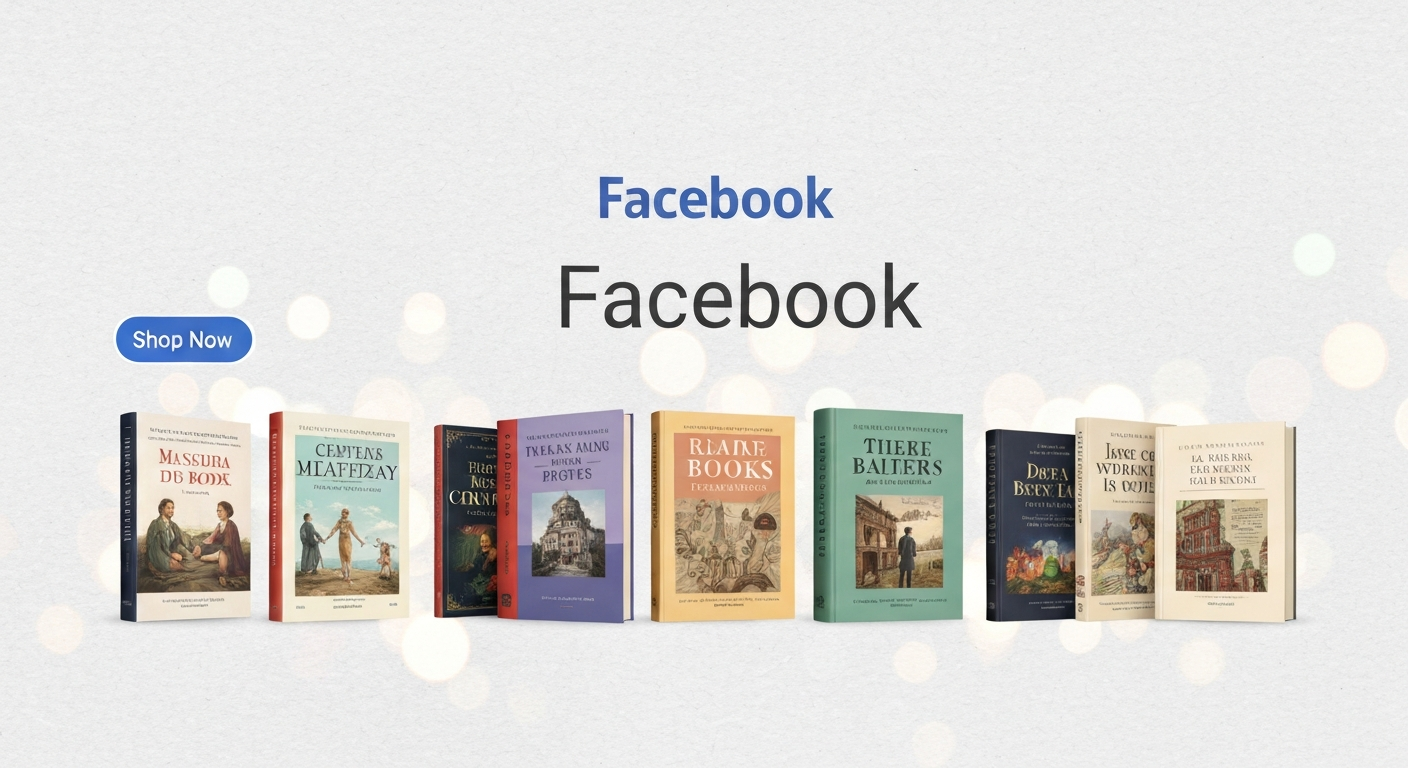
The image is the first thing a reader sees in their feed. For books, the most effective creatives center on the cover itself – displayed clearly, at high resolution, against a background that complements rather than competes with it. Dark backgrounds with contrasting text tend to perform well in fiction, particularly mystery and thriller. Clean, minimal layouts work better for non-fiction, especially when paired with a short benefit statement or a visible review count.
Static images remain the dominant format for book advertising on Facebook. Video ads are worth testing for narrative-heavy fiction or non-fiction with a strong transformation angle, but for most authors, a well-designed static image consistently delivers the best cost-per-click.
Copy: Short, Genre-Specific, Direct
Long sales copy in the primary text almost always underperforms. What works is a tight two-to-three-line structure: a hook tied to the genre or premise, a brief tension tease, and a direct call to action like “Get your copy on Amazon.”
Headlines deserve their own testing strategy. In fiction, trope-driven options – “Second chance romance. One last shot.” – tend to outperform generic titles. In non-fiction, benefit-driven headlines like “Master your mornings in 21 days” align closely with reader interest and curiosity, making them a reliable starting point for stronger click-through rates. The description field (more visible on desktop) is a natural place to add a secondary incentive, such as “Free with Kindle Unlimited” or a limited-time price point.
Facebook Book Ad Examples That Actually Work
Book Cover Focus Ad
It might be obvious, but it bears repeating: leading with the cover is the best eye-catching method. The most widely used Facebook format places the book cover front and center. Add some primary text to tease the plot in two to three short lines, and the headline to reinforce the genre or a key reader benefit. This format works especially well for fiction with a professionally designed cover, because the cover itself carries most of the persuasive weight – readers who recognize the visual style as matching their preferences are already primed to click before finishing the copy.
The old adage “don’t judge a book by its cover” is repeatedly proven false when it comes to online advertising. A strong cover visual is an asset – use it.
Social Proof Ad
Social proof ads lead with reader reactions rather than plot summaries. The image typically features the cover alongside text like “Over 2,000 five-star reviews” or a punchy reader quote: “I had to call in sick to finish this.” The strategic shift here is deliberate. Instead of telling cold audiences what a book is about, social proof ads show them what other readers already experienced – which lowers perceived risk and often converts better than a blurb alone.
Free Sample or Giveaway Ad
Offering a free first chapter, or promoting a discounted first book in a series, drives high-volume clicks at a lower cost per click. It asks less of the reader upfront and makes the first conversion much easier to earn. For series authors, a free or discounted entry-point title significantly increases sell-through to subsequent books.
Copy leads directly with the offer: “Download Chapter One free today” or “Book One in the series is now free.” This approach also doubles as a list-building tool – collecting reader email addresses in exchange for the free download and creating a warm audience for future retargeting.
Campaign Structure That Converts
Use Traffic Objective, Skip Boost
The Traffic objective is the right starting point for most book campaigns. It tells Meta’s algorithm to optimize for clicks from users who have a history of engaging with similar ads – exactly the behavior needed when sending readers to an Amazon or retailer page.
Avoid the “Boost Post” button. It restricts the targeting and bidding options available in Meta Ads Manager and typically delivers lower-quality traffic at a higher cost. For authors selling directly through their own site with the Meta Pixel installed, the Conversions objective becomes a stronger option – but only once enough conversion data has been collected to give the algorithm something meaningful to learn from.
Start With Relevant Parameters, Then Let the Algorithm Expand
Broad targeting has outperformed narrow interest-based targeting for many book advertisers in recent years. Meta’s algorithm, given enough budget and time, identifies patterns in who clicks and converts without needing heavy manual restrictions.
If there’s a clear demographic profile – say, a romance readership that skews female and aged 25-60 – applying those known parameters as a starting filter is a reasonable move. The key is avoiding over-restriction before the algorithm has accumulated enough data to make confident decisions. Meta’s AI-powered Advantage+ Audiences can dynamically refine targeting over time, with some campaigns reporting meaningfully lower average cost per click as a result.
Testing, Budgeting, and Scaling
CTR and CPC Signal Health, ROAS Confirms Profitability
Start with a realistic daily budget – $5-$10 per day is a practical floor for initial testing. Run each ad variation for at least five to seven days before drawing conclusions, and change only one variable at a time (headline, image, or primary text) so performance shifts can be attributed to a specific change.
A rising cost per click combined with a falling click-through rate over multiple days is a reliable signal that the creative needs attention. If an ad gets plenty of clicks but few sales, the issue is almost always the landing page or retailer page, not the ad itself. Return on ad spend (ROAS) is the final confirmation of profitability, but CTR and CPC are the early indicators that tell you whether a campaign is worth scaling.
When an ad is performing well, scale spending gradually – roughly 10-20% per week – rather than making large jumps that can disrupt the algorithm’s optimization patterns.
When and How to Refresh Creative
Creative fatigue is one of the most common reasons profitable campaigns stall. Most authors running active campaigns refresh their creatives every two to four weeks – introducing new images or copy variations without disrupting the overall campaign structure, which preserves what the algorithm has already learned. Keeping the campaign intact while swapping creative is the key to maintaining momentum without resetting performance data.
Discover What’s Already Working
Starting a Facebook book ad campaign from scratch is one of the slowest and most expensive ways to find what works. The faster path is knowing which creative approaches are already performing in your category – and building from there.
Being an author is not the same as being a marketer, which is why so many turn to AI ad platforms for help promoting their work. Brand Spy features, as created by companies like GetHookd, track which publishers, authors, and book marketing brands are actively scaling their ads on Meta right now, including the creatives they’re running and the landing pages receiving their traffic. Combine this with a creative analysis to show which ads in the campaign are performing and which need replacing – backed by real performance data, not vanity metrics. The best platforms will also generate the creative too – videos, posts, image – all tailored for a specific book campaign.
Converting curious readers to committed buyers takes impossibly fast response times and a different kind of skill set. The writing may be the author’s own words, but the advertising? That’s now firmly the realm of AI.
GetHookd LLC
40 SW 13th street
902
Miami
Florida
33130
United States


