The Business Research Company’s The Artificial Intelligence in Games Global Market Report 2026 – Market Size, Trends, And Forecast 2026-2035
LONDON, GREATER LONDON, UNITED KINGDOM, October 26, 2026 /EINPresswire.com/ — The intersection of artificial intelligence and gaming is rapidly transforming the interactive entertainment landscape. With AI technologies becoming increasingly sophisticated, the Artificial Intelligence (AI) In Games market is set to experience remarkable growth in the coming years. This overview examines the current market size, regional leaders, key drivers, and emerging trends shaping the future of AI in gaming.
Artificial Intelligence In Games Market Size and Its Relation to the Media Sector
The Artificial Intelligence (AI) In Games market is projected to surpass $7 billion by 2030. When compared to the broader AI In Media & Entertainment market, expected to reach about $87 billion by the same year, AI in games will make up roughly 8% of this parent sector. Within the vast Information Technology industry, which is forecasted to hit $13,788 billion by 2030, the AI in games segment will represent close to 0.1% of the total market value.
Request A Free Sample Of The Artificial Intelligence (AI) In Games Market Report
https://thebusinessresearchcompany.com/sample_request?id=19134010&type=smp&name=Artificial%20Intelligence%20%28AI%29%20In%20Games%20Market%20Report%202026&utm_source=EINPresswire&utm_medium=Paid&utm_campaign=Oct_PR
North America’s Role as the Leading Region in AI In Games by 2030
North America is anticipated to lead the AI in games market in 2030 with a valuation of $2.5 billion. Starting from $1.0 billion in 2025, this market is expected to grow at a strong compound annual growth rate (CAGR) of 20%. This rapid expansion is largely driven by the concentration of top AI technology firms and game developers in the region, the growing incorporation of generative AI within game development workflows, increased investments in cloud gaming infrastructure, rising consumer demand for immersive and customized gaming experiences, and continual advancements in AI computing platforms that support next-generation game production.
The United States as the Top Country Driving AI In Games Growth
Among all countries, the USA is set to be the largest single market for AI in games by 2030, valued at $2.2 billion. The market is predicted to expand from $0.9 billion in 2025, growing at a CAGR of 19%. This growth is supported by the concentration of major game publishers and AI developers within the country, greater adoption of AI-powered tools for content generation, increased funding in interactive entertainment technologies, a surge in live-service and multiplayer game popularity, and robust innovation in AI-driven game design, testing, and player engagement solutions.
Access The Detailed Artificial Intelligence (AI) In Games Market Report Here
https://thebusinessresearchcompany.com/report/artificial-intelligence-ai-in-games-global-market-report?utm_source=EINPresswire&utm_medium=Paid&utm_campaign=Oct_PR
Software Segment to Dominate AI In Games Market by 2030
Breaking down the market by components, software is expected to be the dominant segment, accounting for approximately 82% or $6 billion of the total AI in games market by 2030. The growth in software is propelled by widespread use of AI development platforms, expanding deployment of generative AI for creating game assets, adoption of intelligent game engines, rising demand for real-time analytics and adaptive gameplay systems, and ongoing improvements in AI algorithms focused on content creation and player interaction.
Key Technologies and Game Genres Within AI In Games
The AI in games market encompasses several technologies, including machine learning, natural language processing, computer vision, gesture control, and other emerging AI methods. In terms of game genres, the market covers action, adventure, puzzle, simulation, role-playing, and other categories. Moreover, the applications span across platforms such as PC gaming, TV gaming, as well as smartphone and tablet gaming.
Forecasted Growth Rate of AI In Games Market Until 2030
The AI in games market is expected to maintain a robust growth trajectory with a compound annual growth rate (CAGR) of 20% through 2030, showcasing strong potential fueled by technological advancements and rising industry demand.
Primary Factors Stimulating AI In Games Market Growth
One of the main drivers behind the market’s expansion is the increasing desire for personalized gaming experiences. Developers are utilizing AI to analyze player behaviors and preferences, enabling customized gameplay through adaptive difficulty, tailored narratives, and personalized recommendations. These enhancements deepen player engagement and boost user retention, adding approximately 1.5% annual growth to the market.
Another significant factor is the growing integration of AI-powered non-player characters (NPCs) and dynamic gameplay mechanics. Intelligent NPCs that respond and adapt to player actions help create immersive and realistic gaming worlds. Meanwhile, AI-driven dynamic environments adjust challenges and interactions in real time, offering engaging and varied gameplay. This trend is projected to add about 1.0% yearly growth to the market.
The increasing use of procedural content generation also plays a crucial role in driving market expansion. AI technologies that automatically generate game elements like environments, missions, and characters help streamline development, reduce production time, and provide nearly limitless gameplay options. This capability contributes around 0.8% growth annually to the overall market.
Key Opportunities in the Software and Hardware Segments of AI In Games
The software and hardware sectors within the AI in games market present the most substantial growth opportunities, with combined contributions expected to exceed $5 billion by 2030. This is fueled by wider adoption of generative AI platforms, deployment of high-performance AI computing infrastructure, demand for intelligent game creation tools, real-time AI integration across gaming platforms, and ongoing investments in scalable AI technology. These developments reflect the industry’s aim to improve development efficiency, enhance player experiences, and advance AI-driven innovation in interactive entertainment.
Growth Trajectory of Software and Hardware Segments from 2025 to 2030
Within this forecast period, the software market is predicted to grow by $4 billion, while the hardware segment is expected to add $1 billion. The AI in games market features a diverse mix of global tech companies, game engine developers, and video game publishers. These players focus on AI-powered game development, procedural content generation, intelligent NPC behavior, and player analytics. Emphasis lies on generative AI, adaptive gameplay systems, real-time decision-making algorithms, cloud-based AI integration, and sophisticated development tools to strengthen their foothold and improve immersive gaming experiences. Scalable AI frameworks, enhanced player engagement, efficient production workflows, personalized content, and cross-platform compatibility remain critical for competitive advantage.
Market Leader in AI In Games and Their Contributions
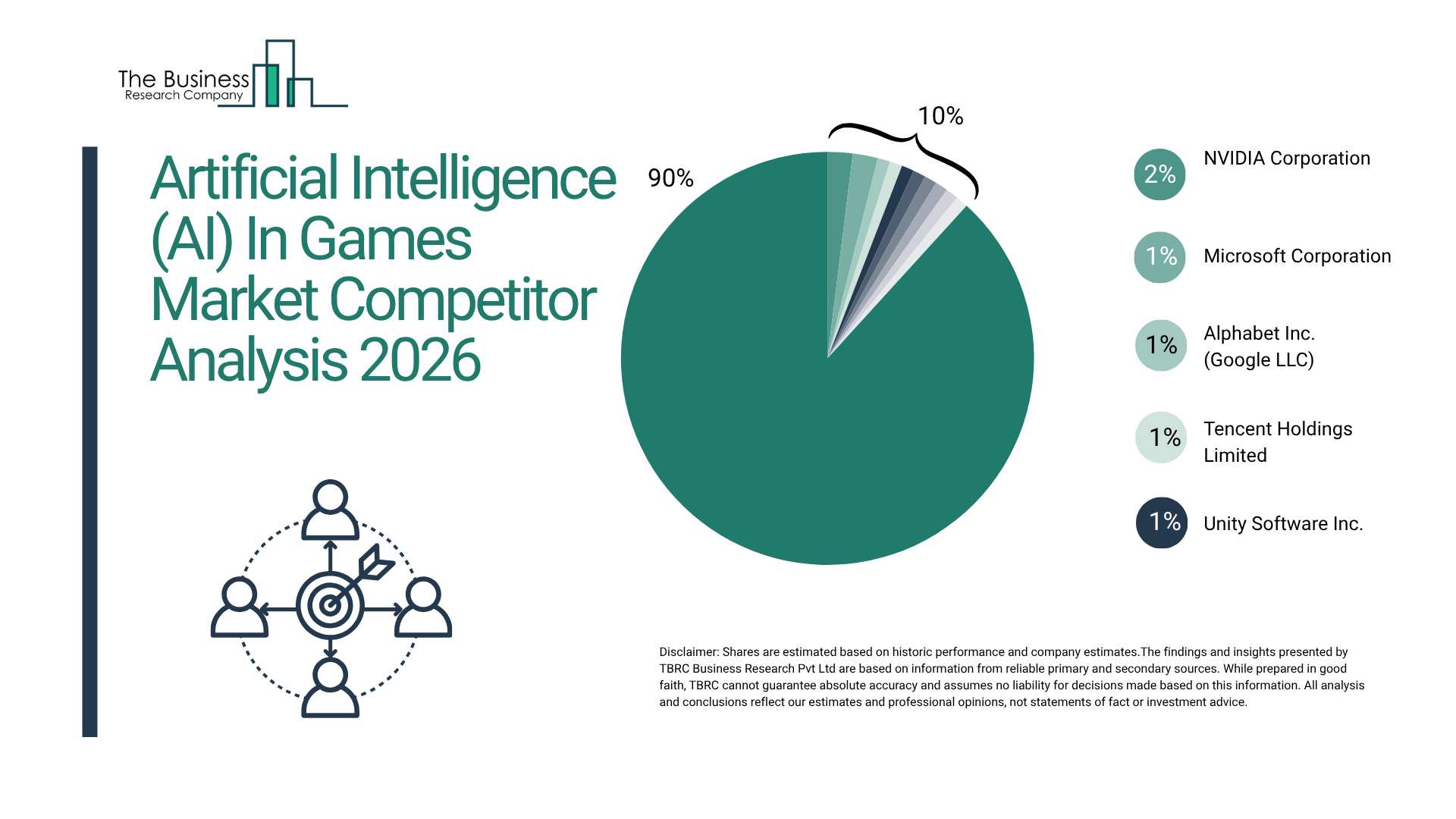
NVIDIA Corporation is recognized as the global market leader in 2025, holding a 2% share. NVIDIA’s AI computing platforms and graphics technologies provide an extensive suite of AI development frameworks, GPU-accelerated computing, generative AI tools, and neural rendering innovations. These offerings support intelligent game development, realistic visuals, advanced character interactions, and high-performance gaming across PC, consoles, and cloud platforms.
Key Players Driving Innovation in the AI In Games Market
The market features many prominent names, including NVIDIA Corporation, Microsoft Corporation, Alphabet Inc. (Google LLC), Tencent Holdings Limited, Unity Software Inc., Sony Group Corporation, Electronic Arts Inc., NetEase, Inc., Activision Blizzard, Inc., Nintendo Co., Ltd., Take-Two Interactive Software, Inc., Ubisoft Entertainment SA, Capcom Co., Ltd., Konami Group Corporation, Square Enix Holdings Co., Ltd., Behaviour Interactive Inc., Playtika Holding Corp., Crytek GmbH, SideFX Software Inc., Insomniac Games, Inc., Vivendi SE, Quantic Dream S.A., Promethean AI, Inc., and Charisma Entertainment Ltd.
Market Concentration and Competitive Landscape
The AI in games market is moderately fragmented, with the top ten companies accounting for 10% of total revenue in 2025. This reflects moderate barriers to entry due to the need for advanced AI expertise, proprietary ecosystems, large-scale computing infrastructure, and ongoing investments in machine learning and generative AI. Leading companies like NVIDIA Corporation, Microsoft Corporation, Alphabet Inc., Tencent Holdings Limited, Unity Software Inc., Sony Group Corporation, Electronic Arts Inc., NetEase, Inc., Activision Blizzard, Inc., and Nintendo Co., Ltd. maintain significant market shares through comprehensive AI platforms, robust gaming ecosystems, strong developer networks, extensive game libraries, and continuous innovation in AI-assisted content creation and player engagement. As demand for adaptive gameplay, AI-generated content, realistic virtual worlds, and next-gen interactive entertainment grows, these firms are expected to solidify their positions through technological innovation, strategic alliances, and expansion of AI-enabled platforms.
Raw Material Suppliers Fueling the AI In Games Ecosystem
Key suppliers providing raw materials and infrastructure in this market include NVIDIA Corporation, Advanced Micro Devices, Intel Corporation, Qualcomm Incorporated, Amazon Web Services, Google Cloud, Oracle Corporation, CoreWeave, Lambda Labs, Cerebras Systems, Graphcore, Hugging Face, Scale AI, Databricks, Snowflake Inc., Stability AI, Mistral AI, Cohere, and OpenAI. These companies provide essential hardware, cloud services, AI frameworks, and data tools critical for AI in games development.
Leading Wholesalers and Distributors in the AI In Games Market
Major distribution channels include platforms such as Steam, Epic Games Store, GOG, Humble Bundle, Green Man Gaming, Fanatical, Microsoft Store, PlayStation Store, Nintendo eShop, Xbox Marketplace, Apple App Store, Google Play, Samsung Galaxy Store, Amazon Appstore, itch.io, Galaxy Store, GeForce NOW, Boosteroid, and Blacknut. These provide broad access to AI-enhanced games and content across multiple devices and regions.
Primary End Users of AI In Games Technology
Key end users integrating AI in games are industry giants like Microsoft Corporation, Alphabet Inc., Tencent Holdings Limited, Unity Software Inc., Sony Group Corporation, Electronic Arts Inc., NetEase, Nintendo Co., Ltd., Take-Two Interactive Software, Ubisoft Entertainment, Capcom Co., Ltd., Konami Group Corporation, Square Enix Holdings Co., Ltd., Behaviour Interactive, Playtika Holding Corp., Crytek GmbH, Insomniac Games, Quantic Dream, and Promethean AI.
Competitive Trends Revolutionizing AI In Games
Generative AI models are reshaping the AI in games market by speeding up development cycles, improving creative workflows, and enabling intelligent content generation for future gaming experiences. For example, in February 2025, Microsoft Corporation introduced Muse, a pioneering generative AI model designed to understand gameplay mechanics and environments by analyzing human play. Muse’s capabilities include AI-driven gameplay generation, rapid prototyping, and smart environment modeling, helping developers produce immersive games faster and fostering innovation in AI-driven game creation.
Strategies Adopted by Companies to Maintain Market Leadership
Leading firms focus on integrating generative AI to enhance intelligent game development workflows and advancing AI-powered NPC technologies to boost immersive player experiences. They also pursue strategic partnerships to accelerate AI innovation across gaming ecosystems, deploy cloud-based AI platforms for scalable real-time game intelligence, and invest in procedural content generation to expand creative possibilities in game design. These strategies collectively support a competitive edge in a rapidly evolving market.
Expanded capabilities in our 2026 market reports:
• Market attractiveness scoring and analysis
• Total addressable market (TAM) analysis
• Company scoring matrix graphics and tables
• Excel-based forecasting dashboards
• Market hotspots infographics
• Key technologies and future trend analysis
• Updated graphics and tables
Learn More About The Business Research Company
The Business Research Company (www.thebusinessresearchcompany.com) is a leading market intelligence firm renowned for its expertise in company, market, and consumer research. We have published over 30,000+ reports across 27 industries and 60+ geographies. Our research is powered by 1,500,000 datasets, extensive secondary research, and exclusive insights from interviews with industry leaders.
We provide continuous and custom research services, offering a range of specialized packages tailored to your needs, including Market Entry Research Package, Competitor Tracking Package, Supplier & Distributor Package and much more.
Disclaimer: Please note that the findings, conclusions and recommendations that TBRC Business Research Pvt Ltd delivers are based on information gathered in good faith from both primary and secondary sources, whose accuracy we are not always in a position to guarantee. As such TBRC Business Research Pvt Ltd can accept no liability whatever for actions taken based on any information that may subsequently prove to be incorrect. Analysis and findings included in TBRC reports and presentations are our estimates, opinions and are not intended as statements of fact or investment guidance.
Contact Us:
The Business Research Company
Americas +1 310-496-7795
Europe +44 7882 955267
Asia & Others +44 7882 955267 & +91 8897263534
Email: marketing@tbrc.info
Follow Us On:
LinkedIn: https://in.linkedin.com/company/the-business-research-company
Oliver Guirdham
The Business Research Company
+44 7882 955267
info@tbrc.info
Visit us on social media:
LinkedIn
Facebook
X
Legal Disclaimer:
EIN Presswire provides this news content “as is” without warranty of any kind. We do not accept any responsibility or liability
for the accuracy, content, images, videos, licenses, completeness, legality, or reliability of the information contained in this
article. If you have any complaints or copyright issues related to this article, kindly contact the author above.

Media gallery