
The Business Research Company’s Digital Twin For Aero Engines Market Report 2026 – Market Size, Trends, And Global Forecast 2026-2035
LONDON, GREATER LONDON, UNITED KINGDOM, November 26, 2026 /EINPresswire.com/ — “The digital twin technology for aero engines is rapidly gaining traction, revolutionizing how aircraft engine performance and maintenance are managed. This innovation is reshaping the aviation industry by offering advanced tools that improve reliability, efficiency, and safety. Let’s explore the market’s current status, growth drivers, segmentation, emerging trends, regional dynamics, and key players shaping this exciting sector.
Market Expansion and Future Projections of the Digital Twin for Aero Engines Market
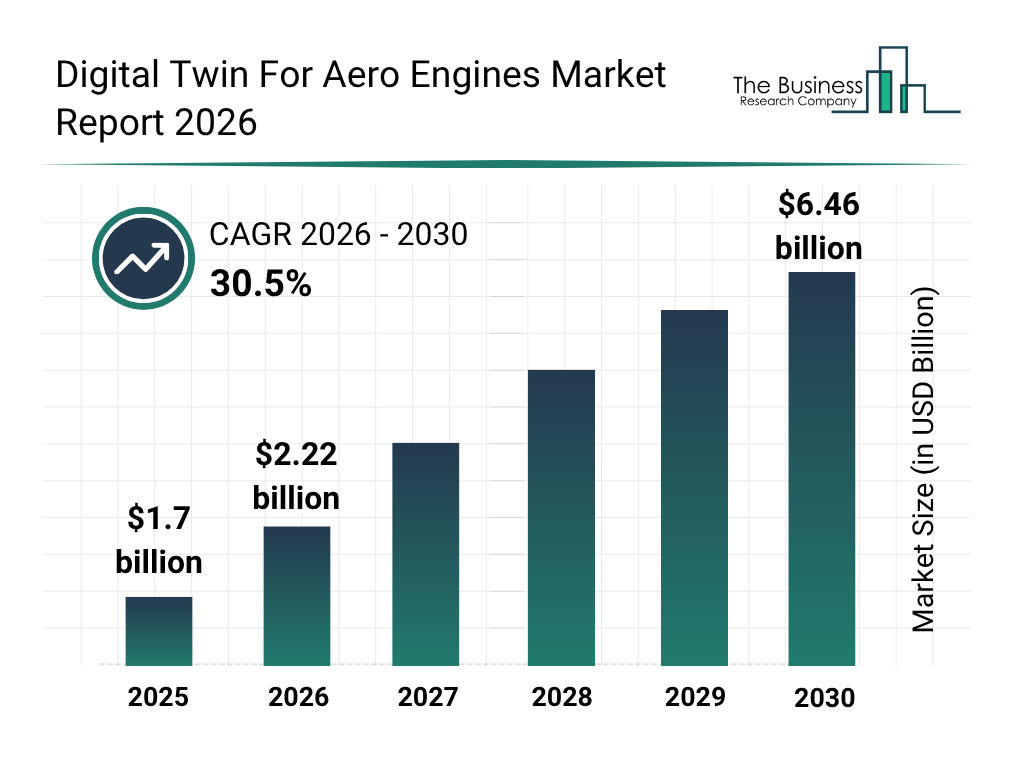
The digital twin for aero engines market has seen remarkable growth lately. It is projected to increase from $1.7 billion in 2025 to $2.22 billion in 2026, reflecting a notable compound annual growth rate (CAGR) of 31.0%. This upward trajectory during the historical period is largely due to rising demands for enhanced aircraft engine reliability, the increasing complexity of aero-engine systems, higher utilization of aircraft fleets, greater focus on predictive maintenance, and the need for optimized engine performance.
Download a free sample of the digital twin for aero engines market report:
https://www.thebusinessresearchcompany.com/sample_request?id=91380351&type=smp&name=Digital%20Twin%20For%20Aero%20Engines%20Market%20Report%202026&utm_source=EINPresswire&utm_medium=Paid&utm_campaign=Nov_PR
Looking ahead, the market is expected to expand significantly, reaching $6.46 billion by 2030 with a CAGR of 30.5%. This anticipated growth stems from broader adoption of digital twin technologies across the entire engine lifecycle, increased demand for real-time engine health monitoring, rising popularity of virtual engine testing, growing requirements for fleet-level performance insights, and deeper integration of digital twins with maintenance, repair, and overhaul (MRO) workflows. Key trends during this forecast period include wider use of physics-based engine modeling, enhanced efforts toward digital twin validation and certification, tailored digital twin solutions for specific engine types, and comprehensive lifecycle-based engine performance simulations.
Primary Growth Factors Driving the Digital Twin for Aero Engines Market
One of the main contributors to market growth is the expansion of commercial aircraft fleets worldwide. These fleets consist of passenger and cargo aircraft operated by airlines on domestic and international routes. The global increase in air travel demand and the airlines’ pursuit of greater operational capacity and fleet efficiency are driving fleet growth. This expansion generates a continuous stream of operational and performance data, which is essential for real-time engine monitoring, predictive maintenance, and lifecycle management through digital twin technology.
View the full digital twin for aero engines market report:
https://www.thebusinessresearchcompany.com/report/digital-twin-for-aero-engines-market-report?utm_source=EINPresswire&utm_medium=Paid&utm_campaign=Nov_PR
For instance, as of August 2025, the International Air Transport Association (IATA), a Canada-based nonprofit, reported that the global commercial fleet included 35,550 aircraft, with 30,300 actively in service. This growing fleet is expected to continue expanding to meet the rising demand for air travel, further propelling the digital twin for aero engines market.
How Market Segmentation Influences Digital Twin for Aero Engines Industry
This market is segmented across several dimensions for a detailed understanding of its structure. By component, it includes software and services. Engine types covered are turbofan, turboprop, turboshaft, and turbojet engines. Deployment modes are categorized into cloud-based, on-premises, and hybrid cloud. Applications span engine design and development, predictive maintenance, performance monitoring, fleet management, and maintenance repair and overhaul. End users range from commercial aviation and military defense to original equipment manufacturers (OEMs) and MRO providers.
Breaking it down further, software subcategories feature digital twin platform software, simulation and modeling software, predictive analytics software, and engine performance monitoring software. Services include consulting, implementation and integration, training, as well as maintenance and support services.
Emerging Trends Shaping the Future of Digital Twin for Aero Engines
Leading companies in this field are innovating by developing advanced solutions such as physics-informed digital twins. These digital twins merge real-time operational data with physics-based models to simulate engine performance more accurately, predict potential failures, enhance flight safety, and decrease maintenance turnaround times.
A notable example occurred in August 2026 when a student team from the National Institute of Technology Karnataka (NITK), Surathkal in India, won Aerothon 2026. Their winning project was a “Physics-Informed Digital Twin for Real-Time Four-Stage Turbojet Health Monitoring,” which processes sensor data from turbojet engines using machine learning to forecast specific engine failure modes before they happen. This breakthrough supports improved safety and efficiency for engine manufacturers, maintenance service providers, and airlines.
Regional Market Trends and Growth Opportunities
In 2025, North America held the largest share of the global digital twin for aero engines market. However, the Asia-Pacific region is predicted to experience the fastest growth during the forecast period. The market report addresses key regions including Asia-Pacific, South East Asia, Western and Eastern Europe, North and South America, the Middle East, and Africa, providing a global perspective on industry trends and opportunities.
Strategic Market Leaders Driving Digital Twin for Aero Engines Advancement
Several major companies are at the forefront of this market’s growth and innovation. These leaders include Microsoft Corporation, Amazon Web Services Inc, NVIDIA Corporation, International Business Machines Corporation (IBM), Accenture plc, Rolls-Royce plc, Dassault Systèmes SE, Capgemini SE, Infosys Limited, HCL Technologies Limited, Hexagon AB, Cadence Design Systems Inc, PTC Inc, The MathWorks Inc, Aras Corporation, Maya HTT Ltd, and Siemens AG. These organizations are instrumental in advancing digital twin technologies and expanding their applications within the aero engine sector.
New strategic additions in our 2026 market reports include market attractiveness scoring and analysis, total addressable market (TAM) analysis, company scoring matrix graphics and tables, Excel-based forecasting dashboards, market hotspots infographics, key technologies and future trend analysis, along with updated graphics and tables.
Speak With Our Expert:
Saumya Sahay
Americas +1 310-496-7795
Asia +44 7882 955267 & +91 8897263534
Europe +44 7882 955267
Email: marketing@tbrc.info
The Business Research Company – www.thebusinessresearchcompany.com
Follow Us On:
• LinkedIn: https://in.linkedin.com/company/the-business-research-company“
Oliver Guirdham
The Business Research Company
+44 7882 955267
info@tbrc.info
Visit us on social media:
LinkedIn
Facebook
X
Legal Disclaimer:
EIN Presswire provides this news content “as is” without warranty of any kind. We do not accept any responsibility or liability
for the accuracy, content, images, videos, licenses, completeness, legality, or reliability of the information contained in this
article. If you have any complaints or copyright issues related to this article, kindly contact the author above.

Media gallery