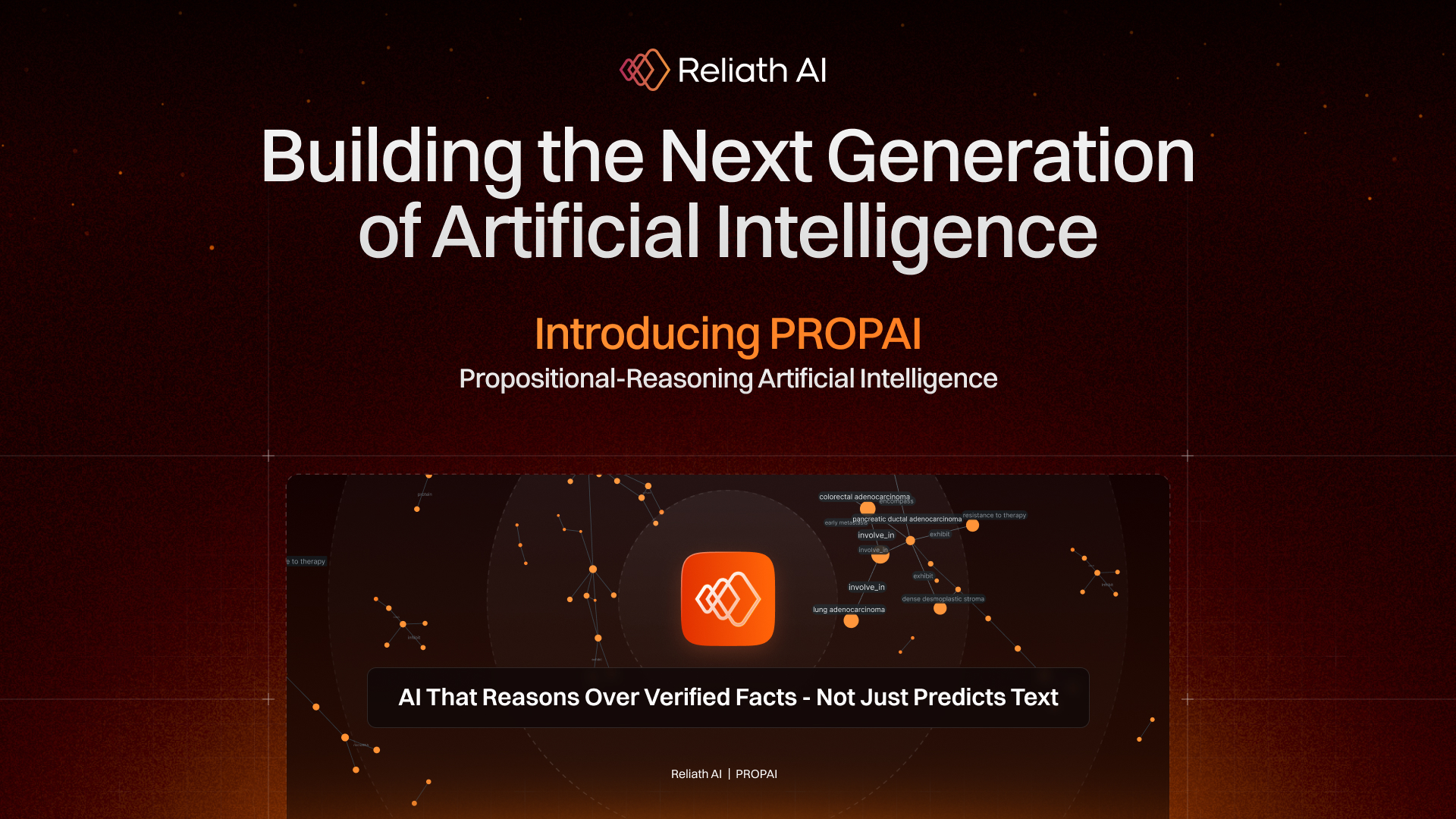

Powered by PROPAI, a non-LLM, GPU-independent architecture designed for mission-critical applications that demand fact-grounded answers.
IRVINE, CA, UNITED STATES, November 26, 2026 /EINPresswire.com/ — Artificial intelligence is becoming embedded in decisions that carry significant financial, operational, regulatory, and safety consequences. Language models produce fluent language, but they are also prone to difficult-to-detect confabulation. Reliath AI addresses that gap with a fundamentally different foundation for AI-one designed to reason over explicit facts and remain accountable to the documents that support its answers.
Reliath AI today announced its foundational model for artificial intelligence, powered by PROPAI (Propositional Reasoning Artificial Intelligence), a fundamentally different approach to AI. Unlike large language models (LLMs), Reliath is not built on next-token prediction or language generation. Its architecture is designed to reason over facts extracted from organization-provided documents.
As organizations move AI from experimentation into consequential workflows, the need is shifting beyond systems that can produce plausible language to systems whose answers can be checked, explained, and traced. Reliath is built around that distinction.
LLMs generate text by predicting likely sequences of tokens. They cannot distinguish truth from confabulation, so they cannot prevent confabulation. The source of information can sometimes be guessed, but many of its supposed sources are themselves confabulations. In contrast, Reliath AI explicitly stores the source of each fact, making Reliath AI verifiable, auditable, and trustworthy. Because of its structure, hallucinations are impossible within a Reliath AI model.
Each Reliath AI model starts empty. Organizations feed their own documents into the system, and those documents become the model’s source of facts. Reliath AI processes the documents and builds a purpose-specific knowledge base from the facts they contain, together with a deterministic reasoning model.
PROPAI represents propositions in two complementary forms: as logical symbolic units that support graph-based reasoning and as semantic vectors, known as truth profiles, that support semantic similarity and flexible query handling. This dual representation allows the system to work with facts as structured units of knowledge rather than generating answers through an LLM’s probabilistic prediction of language.
“AI has been judged by how fluent it sounds, but businesses need competence,” said Dr. Herbert Roitblat, Co-Founder, Chief Technology Officer, and Chief AI Officer at Reliath AI. “PROPAI treats facts as the unit of intelligence. An answer either rests on a fact from your own sources, with the path back to that source, or there is no answer.”
Reliath is designed for mission-critical applications where organizations cannot afford unsupported answers. By grounding its reasoning in organization-defined source documents, maintaining traceability to those sources, and returning no answer when the documents do not support one, Reliath is built for environments where accuracy, accountability, and trust are essential.
Reliath AI requires only a fraction of the computing resources and operating expense associated with today’s large frontier models. This efficiency creates the potential to support the AI needs of organizations around the world from a single data center, rather than requiring every organization to rely on massive infrastructure.
The deterministic architecture means that, given the same query and fact base, the reasoning engine produces the same result. Facts maintain links to their source documents, enabling users to trace an answer back to the document from which its supporting facts were extracted.
Two example applications of Reliath AI are available today, with new ones being created daily. ReliathQ lets organizations view their knowledge bases and answer questions about them. Reliath Harness is a governed runtime environment for agentic AI. For example, a medical research organization could use ReliathQ to support its research by ingesting its own proprietary data into its knowledge base. A regulated organization can use Reliath Harness to control its AI agents, ensuring that they perform only explicitly allowed operations based on true, auditable facts.
Organizations interested in evaluating a fact-grounded alternative to conventional AI architectures can learn more about Reliath AI and request a demonstration at www.Reliath.AI.
Reliath AI is designed to provide a foundation for purpose-built models and applications across industries where accuracy, transparency, traceability, and computational efficiency matter. Relevant industries include pharmaceuticals, energy and utilities, aerospace, healthcare, and financial services-sectors where decisions can carry significant operational, financial, regulatory, or safety consequences.
Reliath AI is advancing a different foundation for artificial intelligence: a non-LLM architecture that starts empty, uses organization-provided documents as its source of truth, reasons over explicitly represented facts, and does not invent answers when the supporting facts are absent.
About Reliath AI
Reliath AI is a leading provider of PROPAI (Propositional Reasoning Artificial Intelligence), a new foundational alternative to large language models. Each model starts empty, trained exclusively on the organization’s documents. Its energy- and computationally efficient architecture is designed to operate with a fraction of the computing resources and costs associated with today’s large frontier models. Reliath AI serves mission-critical industries including pharmaceuticals, energy and utilities, aerospace, healthcare, and financial services. The vision behind the technology is closely tied to the vision for AGI described by Dr. Herbert Roitblat in Algorithms Are Not Enough: creating general artificial intelligence.
Chris LaCour
Reliath AI
+1 949-346-3846
Visit us on social media:
LinkedIn
Legal Disclaimer:
EIN Presswire provides this news content “as is” without warranty of any kind. We do not accept any responsibility or liability
for the accuracy, content, images, videos, licenses, completeness, legality, or reliability of the information contained in this
article. If you have any complaints or copyright issues related to this article, kindly contact the author above.

Media gallery