Commercial vehicles are expanding at a CAGR of 4.5%, fueled by fleet safety compliance in logistics and public transit.
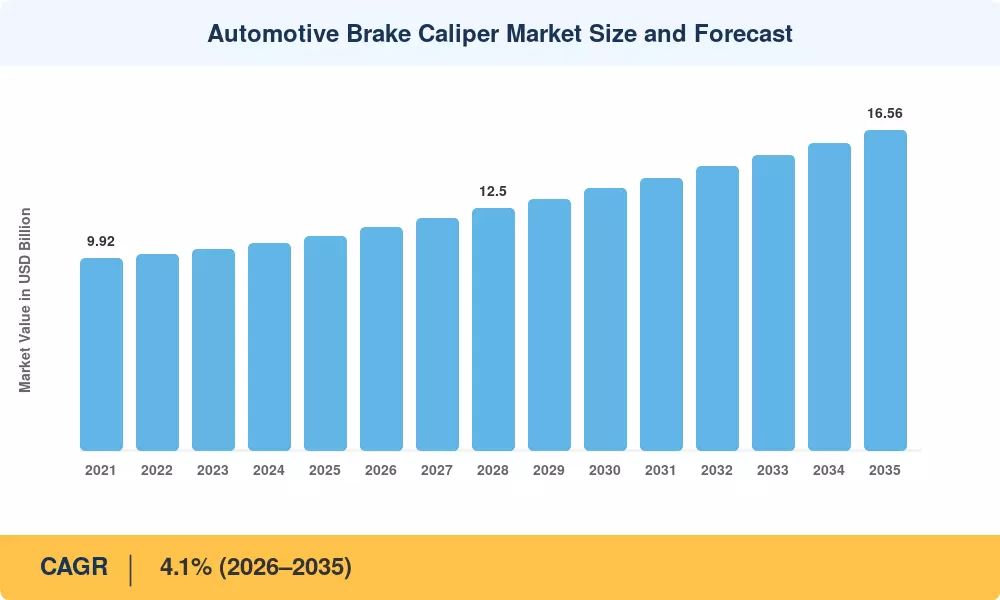
NEW YORK, NY, UNITED STATES, August 27, 2026 /EINPresswire.com/ — According to Market Research Future, the Automotive Brake Caliper Market is projected to grow from USD 11.53 Billion in 2026 to USD 16.56 Billion by 2035, registering a CAGR of 4.1% during 2026 to 2035, driven by Integration of advanced materials and technologies. This steady growth reflects the ongoing evolution of braking systems, where calipers are transitioning from simple mechanical components to sophisticated, sensor-enabled assemblies that support the increasing demands of modern vehicles.
Market Overview
Automotive brake calipers are critical safety components that house the brake pads and pistons, converting hydraulic pressure into mechanical force to clamp the brake rotor and decelerate the vehicle. These components are essential across all vehicle types, from passenger cars and commercial vehicles to two-wheelers. The market encompasses both fixed and floating caliper designs, with piston materials ranging from traditional steel to lightweight aluminum, high-performance titanium, and advanced phenolics. The increasing adoption of electric vehicles, the growing demand for high-performance braking systems, and the integration of electronic and sensor technologies are reshaping the caliper landscape.
The key growth drivers propelling this market expansion include the rising global vehicle production and the expanding vehicle parc, which drive both OEM and aftermarket demand for brake calipers. The increasing adoption of electric vehicles is creating demand for low-drag caliper designs that minimize residual torque and reduce energy consumption, supporting greater EV range. The growing consumer preference for high-performance and premium vehicles is driving adoption of fixed multi-piston calipers, which deliver superior clamping force, reduced brake fade, and enhanced pedal feel. The integration of advanced materials, including lightweight aluminum and carbon-ceramic composites, supports vehicle weight reduction and performance optimization.
Technological developments are reshaping the brake caliper landscape at an accelerating pace. The emergence of brake-by-wire architectures, which eliminate traditional hydraulic connections and replace them with electronic signals and local electric actuation, represents a significant shift in braking system design. Continental’s fourth-generation brake-by-wire system, unveiled in December 2025, achieves full electronic actuation eliminating hydraulic fluid, integrates with vehicle stability control and autonomous driving features, and meets ASIL-D automotive functional safety standards. ZF’s demonstration of a condition-monitoring caliper transmitting real-time pad wear, fluid contamination, and thermal exposure data to vehicle telematics systems further illustrates how brake components are transitioning from passive mechanical assemblies to active nodes within connected vehicle architectures.
The Automotive Disc Brake Market has seen parallel growth, with disc brake adoption expanding across vehicle segments as safety regulations tighten and consumer demand for performance increases. The Brake Pad Market is also evolving, with manufacturers developing sustainable formulations including eco-friendly materials and low-dust compounds to address environmental and performance concerns.
📍 Get Free Sample Report for Detailed Market Insights:
https://www.marketresearchfuture.com/sample_request/7921
Market Segmentation
The automotive brake caliper market is segmented based on vehicle type, caliper type, piston material, and end user to provide comprehensive insights into the industry landscape.
By Vehicle Type: The market serves Passenger Cars, Commercial Vehicles, and Two-Wheelers. Passenger cars constitute the largest segment, driven by high production volumes and the sheer size of the global passenger car parc. The segment’s dominance is supported by frequent brake usage due to daily commuting and urban driving patterns. Commercial vehicles, including light and heavy commercial vehicles, represent a significant segment driven by logistics and freight transport demand. Two-wheelers are witnessing steady growth, supported by rising urbanization and the popularity of motorcycles for last-mile commuting.
By Caliper Type: The market is categorized into Fixed and Floating/Sliding calipers. Floating calipers dominate the market, supported by manufacturing cost advantages and broad applicability across mass-market passenger cars and light commercial vehicles. Floating caliper designs mount rigidly to the steering knuckle on the inboard side while permitting the caliper body to slide laterally on guide pins during brake application, enabling effective pad clamping with a single piston per wheel. This simplification reduces component count and cost. Fixed calipers with opposed-piston configurations deliver superior clamping force distribution, reduced brake fade under extreme duty cycles, and enhanced pedal feel, driving adoption in performance and premium vehicle segments.
By Piston Material: The market covers Aluminum, Steel, Titanium, and Phenolics. Aluminum is gaining significant traction as manufacturers seek lightweight solutions that support vehicle weight reduction and improved fuel efficiency. Aluminum pistons offer excellent thermal conductivity and weight advantages over steel. Steel remains widely used for its durability and cost-effectiveness in mass-market applications. Titanium offers superior strength-to-weight ratio and thermal properties for high-performance applications. Phenolics provide insulation properties and corrosion resistance, finding niche applications in specific brake system configurations.
By End User: The market is divided into OEMs and Aftermarket. The OEM segment holds a significant market share, driven by growing vehicle production and the integration of advanced caliper technologies during manufacturing. The aftermarket segment is witnessing robust growth as vehicle owners seek replacements and upgrades, supported by rising awareness around vehicle maintenance and safety.
By Region: The market analysis covers North America, Europe, South America, Asia Pacific, and the Middle East and Africa.
🛒 You can buy this market report at:
https://www.marketresearchfuture.com/checkout?currency=one_user-USD&report_id=7921
Regional Analysis
Asia Pacific represents the dominant and fastest-growing regional market, driven by the region being the largest automotive manufacturing hub and the rapid vehicle production growth across major economies. China leads the region with the world’s largest automotive market, supported by aggressive government initiatives promoting new energy vehicles and domestic production. The growing demand for passenger cars and the expansion of electric vehicle manufacturing are driving caliper demand. Japan and South Korea are advancing automotive technologies through significant OEM investments and precision manufacturing capabilities. India is gaining traction through expanding vehicle production and rising disposable incomes, contributing to regional market growth.
North America represents a mature and strategically important market, driven by strong consumer demand for safety and performance features, well-established automotive manufacturing, and the presence of major OEMs and suppliers. The United States leads the region with substantial vehicle production and a large vehicle parc generating aftermarket demand. The growing adoption of electric vehicles and the trend toward high-performance braking systems are creating opportunities for advanced caliper technologies. Canada and Mexico contribute through their automotive manufacturing and supply chain integration.
Europe accounts for a significant market share, shaped by stringent safety regulations, strong automotive engineering capabilities, and the presence of premium vehicle manufacturers. Germany leads the region, with prestigious automotive brands driving demand for high-performance and lightweight caliper solutions. The European Union’s stringent safety regulations and commitment to reducing road fatalities are accelerating adoption of advanced braking technologies. The region is also at the forefront of brake-by-wire development, with Continental, Bosch, and ZF leading innovation in electronic braking architectures.
South America and the Middle East and Africa represent emerging markets with growing potential. Brazil is spearheading adoption in South America, driven by expanding vehicle production and improving economic conditions. The Middle East, particularly the UAE and Saudi Arabia, is showing increasing interest in premium and performance vehicles, creating opportunities for advanced caliper technologies.
Competitive Landscape and Key Players
The automotive brake caliper market is highly competitive, featuring a mix of established global suppliers, specialized manufacturers, and regional players. The competitive landscape is characterized by technological innovation, strategic partnerships, and portfolio diversification.
Key players operating in this market include Robert Bosch GmbH, Continental AG, Brembo SpA, ZF Friedrichshafen AG, Akebono Brake Industry Co., Ltd., Aisin Corporation, ADVICS Aftermarket North America, and Nisshinbo Brake Inc. These industry leaders are investing heavily in research and development to create advanced caliper solutions that support electrification, lightweighting, and electronic braking architectures.
Strategic developments are reshaping the competitive landscape. In November 2025, Bosch secured a multi-year supply agreement with a leading Chinese EV manufacturer for an integrated regenerative brake system combining low-drag calipers, electronic control modules, and software-based energy recovery optimization. This deployment illustrates how major Tier 1 suppliers are structuring complete-system offers rather than isolated caliper components in the EV segment. Continental’s December 2025 unveiling of its fourth-generation brake-by-wire system marks a significant commercial milestone, with production launch scheduled for 2027 model year electric vehicle platforms from German premium OEM customers. A March 2025 consortium initiative by Bosch, Continental, and ZF to establish standardized brake-by-wire interface specifications accelerates OEM adoption by reducing integration complexity.
Innovation and technology initiatives are accelerating across the industry. Companies are developing EV-specific caliper designs with enhanced corrosion protection to address extended static periods between friction braking events. The integration of sensors for pad wear monitoring, fluid contamination detection, and thermal exposure data is enabling predictive maintenance and condition-based service intervals. Brand differentiation through distinctive caliper aesthetics, including custom paint finishes and logo badging, has created a secondary demand driver independent of pure braking performance.
Latest Industry News and Developments
Recent industry developments highlight the dynamic nature of the automotive brake caliper market. In March 2025, GSF Car Parts expanded Brembo product offerings in the U.K., demonstrating the growing importance of premium aftermarket braking solutions. TRP launched new hydraulic disc brakes EVO PRO and EVO X, expanding the range of available braking options for commercial vehicle applications.
In August 2024, Bendix EV introduced replacement disc brake pads specifically designed for electric vehicles and hybrids, addressing the unique wear patterns and corrosion challenges associated with reduced friction braking frequency in EVs. In April 2024, MAT Foundry Group developed intelligent brake discs with integrated sensors, illustrating how braking components are evolving into connected, data-generating nodes within vehicle architectures.
In January 2025, Brembo launched a direct-to-consumer e-commerce platform enabling custom caliper configuration specifications, illustrating how leading brands are monetizing aesthetic preference directly and expanding their reach in the aftermarket.
Market Challenges and Opportunities
The automotive brake caliper market faces several key challenges that could impact growth trajectories. The increasing complexity of brake-by-wire and integrated caliper systems requires substantial investment in engineering and validation resources. The elevated cost of advanced materials, including aluminum, titanium, and carbon-ceramic composites, can limit adoption in mass-market applications. Regulatory compliance across different regions adds complexity to product development and market entry strategies.
Emerging opportunities are abundant in the evolving mobility landscape. The accelerating adoption of electric vehicles creates significant demand for low-drag caliper designs that minimize residual torque and energy consumption. The shift toward brake-by-wire architectures presents opportunities for integrated electronic braking solutions that combine calipers, sensors, and software. The growing aftermarket for replacement and upgraded caliper systems offers sustained demand for cost-effective, durable components.
Future growth potential remains steady, driven by the ongoing vehicle production growth, the expansion of the global vehicle parc, and the increasing technological sophistication of braking systems. As electrification and automation continue to reshape the automotive industry, brake caliper manufacturers that embrace lightweight materials, electronic integration, and connected vehicle technologies will be well-positioned for sustained growth.
To explore more market insights, visit us at:
https://www.marketresearchfuture.com/reports/automotive-brake-caliper-market-7921
Final Market Summary
The automotive brake caliper market is positioned for steady growth, driven by technological advancement, vehicle production expansion, and the increasing demand for safety and performance features. The market’s trajectory from USD 11.53 Billion in 2026 to USD 16.56 Billion by 2035 reflects the critical importance of calipers in modern braking systems and the ongoing evolution toward more sophisticated, integrated solutions.
The long-term industry potential remains positive, with advancements in materials science, electronic braking, and connected vehicle technologies continuing to expand the capabilities and applications of brake calipers. The convergence of caliper systems with broader vehicle electronics, including ADAS, autonomous driving, and telematics, is creating opportunities for integrated solutions that serve diverse customer needs.
Key factors expected to influence future development include the pace of vehicle electrification, advancements in brake-by-wire technology, and the evolution of regulatory frameworks. The development of standardized interfaces for electronic braking will accelerate OEM adoption and reduce integration complexity. Investments in lightweight materials, sensor integration, and predictive maintenance capabilities will enable manufacturers to meet the evolving demands of modern vehicle platforms.
The transformation from purely mechanical components to sensor-enabled, electronically controlled assemblies represents a fundamental industry evolution, positioning brake calipers as essential components of the broader automotive safety ecosystem. As vehicles become increasingly connected, electric, and automated, the role of brake calipers will continue to evolve, ensuring sustained relevance and gradual market expansion throughout the forecast period and beyond.
More Related Reports from MRFR Library:
Electric Vehicle Wiring Harnes Market : https://www.marketresearchfuture.com/reports/electric-vehicle-wiring-harnes-market-35914
Three Wheel E Scooter Market : https://www.marketresearchfuture.com/reports/three-wheel-e-scooter-market-35956
Ignition Interlock Device Market : https://www.marketresearchfuture.com/reports/ignition-interlock-device-market-36095
Railway Sliding Bearing Market : https://www.marketresearchfuture.com/reports/railway-sliding-bearing-market-36104
Off Highway Vehicle Hvac Market : https://www.marketresearchfuture.com/reports/off-highway-vehicle-hvac-market-36891
Motor Home Market : https://www.marketresearchfuture.com/reports/motor-home-market-36922
Tire Inspection System Market : https://www.marketresearchfuture.com/reports/tire-inspection-system-market-37118
Rubber Transmission Belt Market : https://www.marketresearchfuture.com/reports/rubber-transmission-belt-market-37855
Automotive Brake Booster Market : https://www.marketresearchfuture.com/reports/automotive-brake-booster-market-38237
Automobile Ancillary Market : https://www.marketresearchfuture.com/reports/automobile-ancillary-market-38269
Market Research Future
Market Research Future
+1 855-661-4441
email us here
Legal Disclaimer:
EIN Presswire provides this news content “as is” without warranty of any kind. We do not accept any responsibility or liability
for the accuracy, content, images, videos, licenses, completeness, legality, or reliability of the information contained in this
article. If you have any complaints or copyright issues related to this article, kindly contact the author above.

Media gallery